Measuring the Mode Shift Funnel: Matches are Leads, But Verified Trips are Results
Article from CommuteHub by RideAmigos, a Champion-Level Corporate Partner.
By Kathryn Hagerman Medina of CommuteHub by RideAmigos

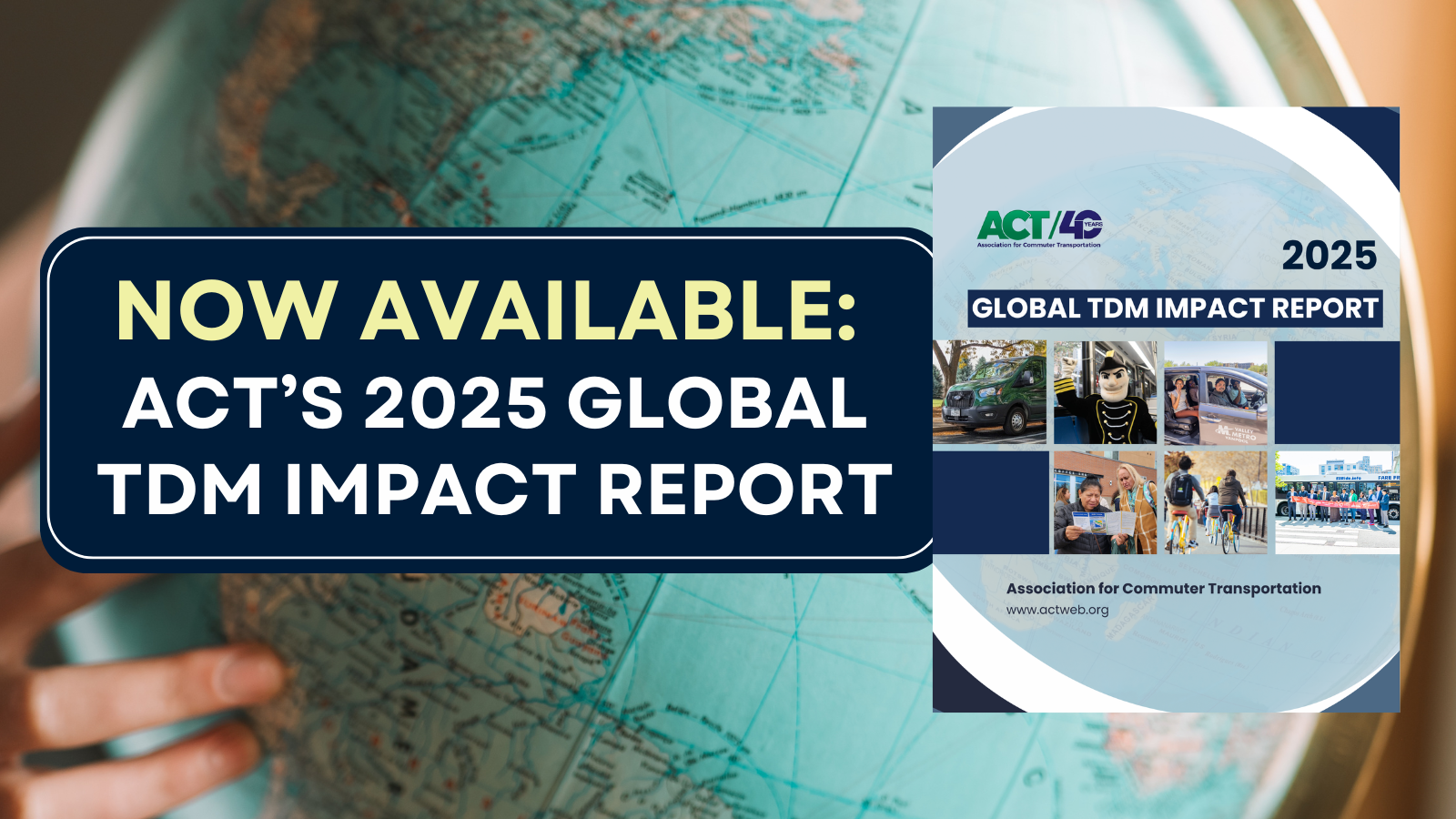
This year and last, I traveled to as many transportation events as possible: regional events, parking and mobility tradeshows, academic conferences, research presentations, ACT's delegation to the UK, and the 40th International Conference. As I talk with our peers and others in the transportation industry, I've noticed something and want to share it with you. TDM is getting more attention and earning more respect. In the past year, ACT published a Global TDM Impact Report and the first comprehensive assessment of carpooling in decades. A growing number of you have earned or are working toward a TDM-CP credential. And now, a second wave of TDM organizations is earning accreditation. A field in which we often joke that our own moms don't understand what we do is starting to show up in more rooms and at more tables where transportation planning and mobility are discussed.
ACT is helping to elevate the level of play, and we are being called to demonstrate the real impact of this important work. It's time to look closely at how we measure success. When funders look at our projects, they are less interested in how much we do than in the outcomes. Page views, email opens, social media likes, sign-ups, and ridematch databases might be leading indicators, but they are not results. Mode shift should be measured in verified trip data: how many people carpooled, who didn't park a car at work, who tried transit during a challenge and was still using it three months later. Real behavior data that stands up to scrutiny supports funding, provides insight to improve our strategies, and earns TDM a seat at the transportation planning table.
Our field is moving beyond tracking leads to measuring outcomes. The good news is that trip verification and behavior data are catching up with our ambitions, and by leveraging them,we can turn good work into programs that truly transform campuses, regions, and our world.
The service still matters — and it works
Before I go too far, let me be clear that educating people about their options and facilitating ride-matching are important services with or without verified carpool trips. Organizations that use CommuteHub know the value of truly personalized recommendations and relevant carpool matches. This knowledge has been passed down to us from our TDM pioneers from the MapQuest and Excel days, and it has been proven at scale. In randomized controlled trials in Durham, run by the City with researchers at Duke and powered by RideAmigos technology, personalized commute plans alone reduced drive-alone trips by more than eight percentage points, with no incentives attached. Research like that is why we've invested so much in personalization at RideAmigos, whether people meet it in an app or by simply asking an AI agent from wherever they already are.
Outreach activities, marketing engagement, and app signups are valuable, and how you execute on them matters. For many organizations, especially public TDM programs, they may even be core to your performance measures. But they are not the results we're all aiming for. Mode shift is. When it comes to trip-reduction targets, air quality goals, parking supply challenges, and access to jobs, the question goes beyond how many people we reached. The success metric is how many trips we changed, and whether we can prove it. To make a marketing analogy, the program is the campaign, engagement is a lead, and mode shift is the result.
Verification is catching up with our ambitions
We're all familiar with the classic commute calendar, where program participants log their trips for each day they commute. Your most engaged members love to see their trip history, mileage stats, savings, and CO2 reductions. And when you have lots of people logging—especially when they can set up autologs in perpetuity or log multiple days with a few clicks—the numbers add up. However, many of you are rightly skeptical about what this data means. I hear it at every conference. On one hand, we want more people to participate so we need to make it easy. On the other hand, what does it mean when a person self-reports bike or carpool trips every day for a year?
Still, verified trip data may seem out of reach. The people you need to reach may be tracking their activities in other apps, but you don't have access to that data, and you know you can't ask them to log trips in multiple places. Our team spends every day thinking about trip data: where it is being created, what we can learn from it, and how it can support your TDM programs. When you think this way, the puzzle starts to come together: A parking transaction. A transit pass tap. A GPS-recorded trip, including carpools confirmed between driver and rider. A bike ride tracked in a fitness app. A shared ride with a public or private mobility provider. These come from the CommuteHub app itself as well as through integrations with apps and environments your members already use every day, connected in ways that support your mode shift and parking management programs. All of it is real behavior, verified without asking anyone to log anything twice (or perhaps at all). And it's getting easier and more comprehensive all the time.
We have been experimenting with this for a long time and we love to share what we learned the hard way, because I suspect some of you are weighing the same choices. For example, an early version of our app offered passive background tracking. The idea was that it could make it easier for users to confirm and share more trip data. Experience taught us (and our best customers told us) that it wasn't good enough. Accuracy suffered, batteries drained, and it aged badly against evolving privacy protections. That system is not aligned with what users now expect from technology they trust. I could write a whole article just about all the problems with trying to track carpools and vanpools passively. So we rebuilt verification around methods people opt into and understand: active recording that works like a run tracker, verified events like parking and passes, and integrations with services that hold real trip data. We'll partner with anyone whose verified trips serve the people our customers serve. CommuteHub is a complete, open TDM solution, not a silo.
Proof earns TDM more resources and a seat at the table
The best thing about committing ourselves to better data is that verification doesn't just document behavior change. It can empower you to do even more. When trips are verified, incentives can reward what people actually do, and that feedback loop is what builds lasting habits. Whoever approves your budget is more likely to support programs like parking or express lane discounts for carpoolers, fully subsidized guaranteed ride home, cash rewards, paid time off, or other high-value incentives when you can prove they directly resulted in verified trips. And users are far more likely to engage and share trip data when these kinds of incentives are on the table. We see it in our own data: about three of every four commuters who log verified trips this month will be back logging next month, and active users record roughly twenty-five verified trips a month.
It's obvious to all of us that TDM delivers congestion relief for cents on the dollar compared to building capacity, and there are anecdotal examples everywhere. Maybe you've heard of the Bridge Bucks program that helped mitigate traffic impacts of the Woodrow Wilson Bridge replacement—a project that came in $86 million under budget while paying people to skip the commute or carpool. Incentives over the long run have been harder to justify, but we know they can save or delay billions in infrastructure spending. If you attended the session at the International Conference in Philadelphia, you know that the Oregon Health & Science University team was able to put off a nine-figure capital investment in a new parking structure for at least ten years with smart TDM policies, including parking pricing and incentives. They explained how their model, supported by real data, helped them get a million-dollar-a-year TDM budget.
With the technology available today, organizations responsible for trip-reduction compliance can know how they're doing and influence people at the margins before the first survey ever goes out. This is what will earn TDM a seat at the planning table. Verified data is how TDM levels up from advocacy to proof.
Let's keep proving TDM does the work
TDM is showing up in more rooms because this community is earning it with hard work, rigorous credentials, program accreditation standards, and results. The way we keep our place in those rooms is to measure our work fanatically. Leading indicators should guide us to real results. But we should open up the books on outcomes in terms of verified trips, verified mode shift, and verified impact. The next time someone asks what TDM does, imagine answering with verified data from your own program—how many people really chose shared modes, how did your campus modesplit change over time. That's a record of impact, and every one of you is already building it.
Our field has never been better positioned to prove what we've always known: good TDM strategies are effective, efficient, and equitable. I'd love to hear what's working for you so please hit me up on LinkedIn (https://www.linkedin.com/in/kehagerman/), in Connect, or pull me over at the next conference!