The State of Carpooling in 2026
ACT held its first Carpool Action Summit, organized by its Carpool Council, this summer as part of its 40th Annual International Conference in Philadelphia, Pennsylvania. The Summit convened 70 carpooling stakeholders from the private sector, government, transit agencies, universities, non-profits, and technology firms to share perspectives on the barriers and opportunities facing carpooling today.
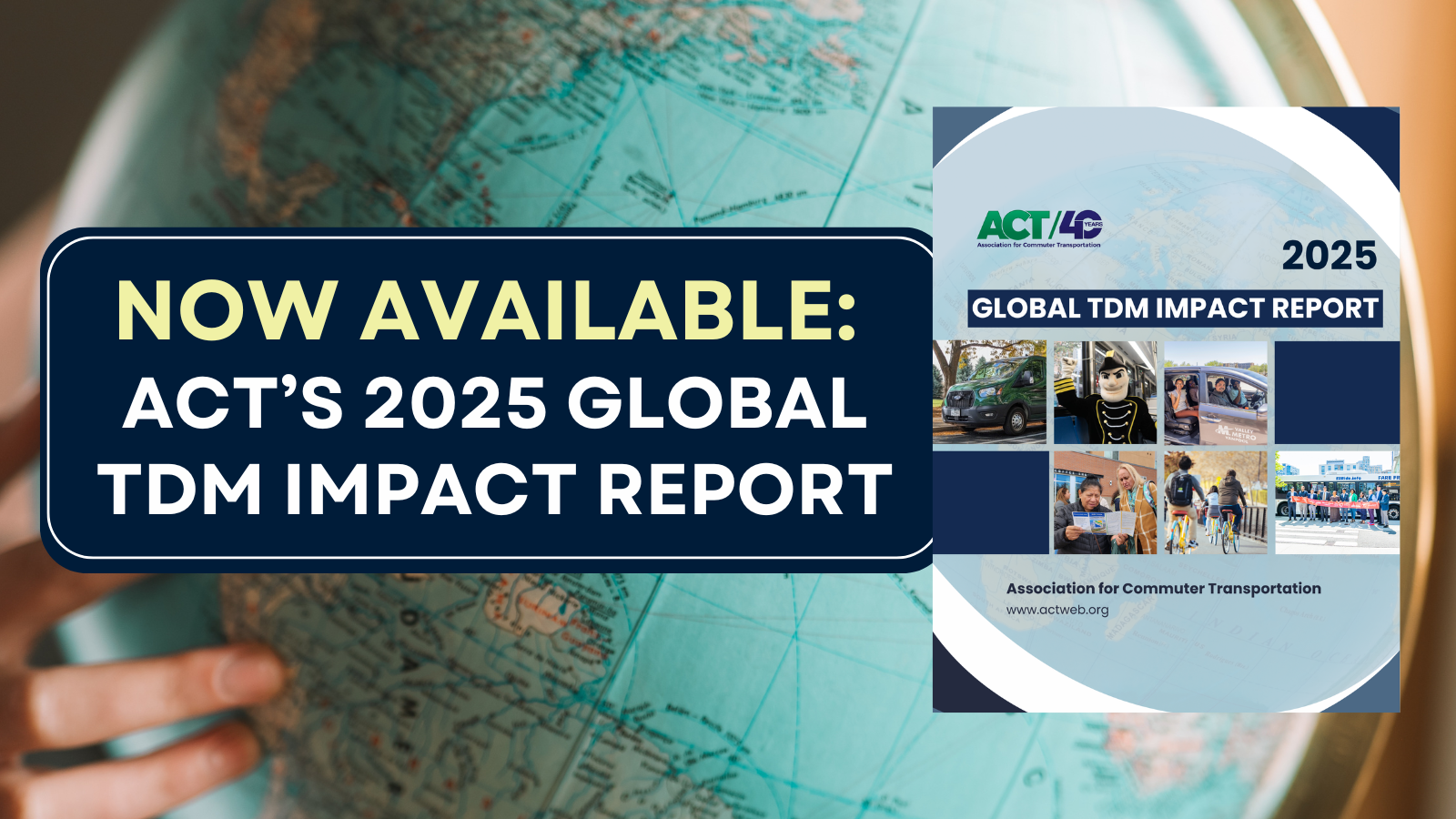
ACT also released its new study, The State of Carpooling 2026: Global Trends, Case Studies, and Implications, based on an examination of ten high-performing carpool programs. The Summit closed its daylong agenda with focused discussions among attendees, organized around five key subject areas, aimed at identifying initiatives that could meaningfully increase carpooling use and shaping plans for future work.
Stakeholder Perspectives
The Summit opened with a panel of carpooling stakeholders representing a major employer, a state department of transportation, a metropolitan planning organization (MPO) from a large, urbanized area, a major transit operator, and a non-profit transportation management association (TMA) serving a suburban region. Each panelist spoke to the value of carpooling for their organization, the obstacles to expanding its use, and the external factors working against it.
The state DOT described navigating political, financial, behavioral, and land-use challenges to establish state support for carpooling as a congestion-reduction strategy and to secure funding for programs statewide. The transit operator viewed carpooling as an important way to encourage commuters to consider shared ride services as a steppingstone to moving into vanpools and ultimately into their bus and rail services. The agency found that the use of incentives was as a critical complement to recover from the falloff in ridership after COVID. The TMA wanted to grow carpooling but faced strong headwinds from the local car culture and low public awareness. The employer wanted to get more of his employees to use carpooling but faced several obstacles including lack of support from senior leadership to favor carpooling by offering priority parking for carpoolers, burdensome governmental regulations that diverted worksite managers from using their time to promote carpooling rather than fulfilling survey requirements, and the lack of hard data to show management the benefits of carpooling and its positive ROI. The MPO, which had promoted carpooling for years, had seen momentum stall during the COVID-19 pandemic and was now testing new incentive programs to bring commuters back.
Findings from the State of Carpooling Study
Mia Zmud and Johanna Zmud, Partners, Blue Door Strategy & Research, ACT’s consultants for the carpool study, then presented their findings. The research used a four-phase approach: a literature review spanning more than 80 years of carpooling research; a survey of domestic and international carpooling experts; a synthesis of those findings to identify common themes and inform case-study selection; and in-depth case studies of five U.S. and five international programs. The expert survey revealed limited awareness of successful programs industry-wide, requiring the team to supplement it with outside research. The literature review drew on studies from the 1940s to the present, examining program models, benefits and barriers, behavioral drivers of participation, institutional frameworks, enabling technologies, and international comparisons. Findings across the literature review, expert survey, and case studies converged around six dimensions associated with stronger carpool program performance. Together, these findings became the basis for a new Carpool Program Diagnostic Framework for evaluating program strengths, constraints, and opportunities for improvement.
The literature review described a striking adoption paradox: even as the benefits of carpooling have become increasingly well established, participation has continued to decline. The research also highlighted an important value mismatch: many of carpooling's benefits accrue to society, while much of the coordination burden is borne by the individual traveler. Technology has reduced the friction of joining a carpool but hasn't reduced the underlying burden. Looking internationally, the literature review noted that the role carpooling plays varies substantially depending on broader transportation, land-use, and economic conditions. India stood out as an important example, where rapid urbanization, severe congestion, long commute distances, and transportation costs have created unusually strong market conditions for carpooling.
The literature review also found a disconnect within the TDM profession: practitioners tend to treat behavior change as a supplement to program design, while the behavioral research on carpooling shows it should be central to it. On a more encouraging note, the review identified a positive trend toward integrating carpooling into broader mobility systems rather than marketing it as a standalone service. It distilled six conditions essential to a successful program: behavioral effectiveness, institutional support, technological capability, financial viability, measurement and accountability, and organizational resilience. The strongest programs aren't defined by excelling in just one area — they perform adequately across all six. The review closed with guidance on what success looks like, and common pitfalls, for each dimension.
Lessons from the Case Studies
The next presentation covered findings from the ten case studies. The portfolio spanned six countries and three organizational models: three U.S. programs operating within a public mobility infrastructure, four international programs run as national or multi-region platforms, and three employer-centered programs (two U.S., one international). The portfolio was deliberately built to capture different kinds of strength rather than a single definition of success — since success can mean strong growth, long-term resilience, measurable outcomes, adaptability over time, or sustained viability.
One notable surprise: the researchers had expected to find successful, replicable voluntary programs, but instead found remarkably few. That led them to shift focus toward identifying patterns across program types more broadly.
Encouragingly, the case studies aligned closely with the literature review's six dimensions of high-performing programs, reinforcing: financial capacity, institutional capacity, behavioral capacity, technological capability, adaptability and resilience, and measurement and learning. Together, these findings became the basis for a new Carpool Program Diagnostic Framework — a tool for evaluating programs not against a single best practice, but against whether they demonstrate strength across all six dimensions.
The case studies also surfaced several broader truths: carpooling is inherently difficult; no single factor explains a program's performance; truly voluntary programs are rare; exemplary programs are hard to find; and growth alone doesn't equal success. Related themes emerged as well — no single model works everywhere, context matters more than replication, and carpool programs function as systems, not apps. The central takeaway from the study, echoed throughout: no single factor explains program performance.
The Technology Panel
The morning's final session brought together representatives from six leading carpool technology companies to discuss how the technology has evolved, current challenges, and what lies ahead. Panelists traced ridematching's evolution from spreadsheets and bulletin boards to today's dynamic, app-based matching. They emphasized that overcoming behavioral barriers is critical, noting a shift in focus from matching people to matching trips. With the rise of hybrid work since COVID, offering rides on an as-needed basis has proven more effective than building long-term carpool relationships. Panelists also noted that morning commutes lend themselves to carpooling more readily than the trip home and stressed the importance of personalizing matches to individual preferences rather than simply surfacing a list of people making similar trips.
Incentives came up repeatedly as key to both launching and sustaining carpool usage, and panelists agreed that minimizing friction in their apps remains essential. On AI and autonomous vehicles (AVs), the group saw both risks and opportunities: AVs could worsen congestion but might also enable stronger guaranteed-ride-home programs, while AI could help personalize the user experience. Finally, panelists noted a broader shift in their business models — from standalone carpool apps to full TDM platforms that help users find the most convenient travel option for any given trip.
Turning Insights into Action
In the afternoon, attendees used the morning's findings to develop initiatives ACT could pursue to reduce barriers to carpooling and strengthen support for it. Participants rotated through five focus areas — Policy and Planning; Institutional Support; Behavioral Factors and Incentives; Technology and Trip Verification; and Data Collection — generating several dozen initiatives, which attendees then prioritized within each category. Because several of these initiatives would require federal legislative action, ACT's government affairs consultants gave attendees an overview of the legislative process and the outlook ahead. The Summit closed with a summary of next steps including further meetings to refine and develop high-priority initiatives.
Call for Volunteers
The Carpool Action Summit culminated with the development of many initiatives that attendees felt could help in making carpooling a more available and significant travel option for many commuters and others. The Carpool Council must now translate these suggestions into concrete and detailed proposals that can be implemented over the next two years. We will be constituting several working groups to focus on the highest priority initiatives as determined through a consultation process with Council members.
Larry Filler is President of the TDM consulting firm, LF Consulting and serves as Chair of ACT’s Carpool Council. Larry wants to thank Mia Zmud, Partner, Blue Door Strategy & Research, for her help with the summary of the State of Carpool Study presentations.
Copies of ACT's State of Carpooling 2026: Global Trends, Case Studies, and Implications are available at actweb.org/products/state-of-carpooling-2026.
ACT will host a webinar and roundtable discussion on the State of Carpooling report and its implications on October 1: "Reinvigorating Carpooling: What ACT's State of Carpooling Study Means for Practitioners, A Roundtable Discussion."